
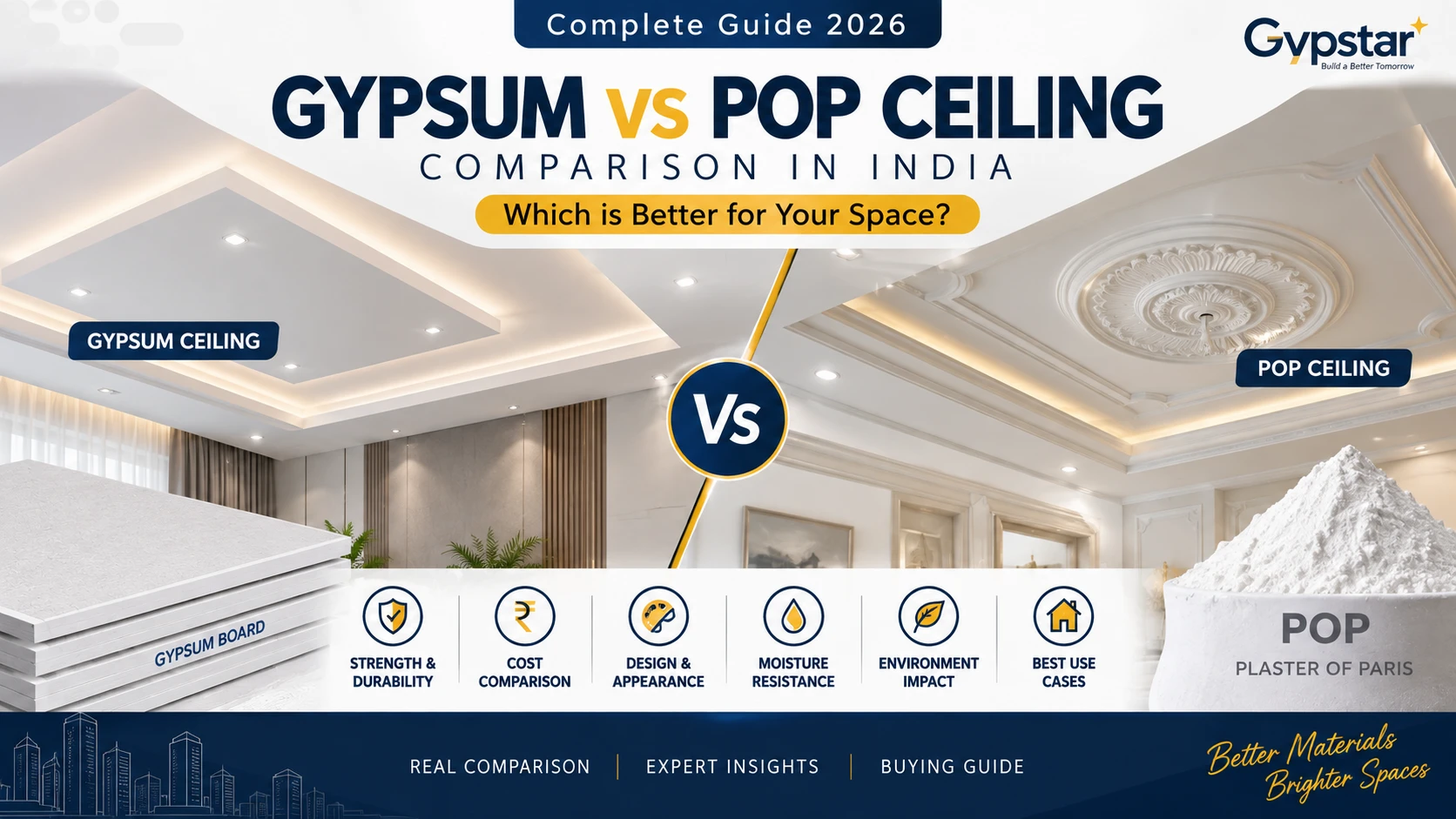
- What is gypsum ceiling vs POP ceiling — key material differences
- Full comparison: cost, durability, finish, moisture resistance & fire rating
- Gypsum vs POP ceiling cost per sq ft — India 2026 price data
- Which is better for residential projects
- Which is better for commercial & institutional projects
- Common buying mistakes contractors & builders make
- How to choose the right material for your project
- 10 FAQs answered
When specifying or procuring false ceiling materials for a residential, commercial, or institutional project in India, the single most debated choice remains: gypsum vs POP ceiling. Both materials have been used extensively across India for decades — but they are fundamentally different in how they are manufactured, how they perform over time, and how much they cost at the material level. This guide breaks down every major factor so that architects, contractors, builders, and procurement teams can make the right material decision for their specific project requirements.
Note: This guide covers material selection, specifications, and procurement only. It does not cover installation, labour, or design services.
What Is Gypsum Ceiling vs POP Ceiling? — Key Differences
What Is a Gypsum Board Ceiling?
A gypsum board ceiling uses factory-manufactured plasterboard panels — made from a calcium sulfate dihydrate (gypsum) core sandwiched between two paper liners — fixed to a galvanised steel channel framework suspended from the slab above. Gypsum boards are produced under controlled factory conditions to precise thickness tolerances, standard sizes, and consistent density. In India, the standard gypsum board for false ceilings is 12.5mm thick and conforms to IS 2095 (Part 1).
Variants available from Indian manufacturers like Gypstar India include standard gypsum boards, moisture resistant (MR/green board) variants, fire resistant boards, and PVC laminated gypsum ceiling tiles — each suited to specific application environments.
What Is a POP (Plaster of Paris) Ceiling?
POP (Plaster of Paris) is calcium sulfate hemihydrate — a powder produced by heating gypsum to approximately 150°C to drive out most of its water content. On-site, POP powder is mixed with water to form a workable paste which is applied wet over a wire mesh or wooden/metal framework by skilled workers. Unlike gypsum boards, POP ceilings are created entirely on-site with no factory-controlled manufacturing process — meaning finish quality depends heavily on the skill of the individual worker.
Gypsum vs POP Ceiling — Full Comparison Table
| Factor | Gypsum Board Ceiling | POP Ceiling |
|---|---|---|
| Manufacturing | Factory-manufactured — consistent quality | On-site applied — quality depends on worker skill |
| Material Form | Ready-made boards — dry process | Powder mixed with water — wet process |
| Thickness Consistency | Precise — 9.5mm, 12mm, 12.5mm, 15mm | Variable — depends on application |
| Material Cost | ₹26–₹55 per sq ft (board only) | ₹15–₹35 per sq ft (material only) |
| Crack Resistance | Excellent — no shrinkage cracks | Poor — hairline cracks common over time |
| Moisture Resistance | Good (MR variant: excellent) | Poor — absorbs moisture, sags in humid areas |
| Fire Resistance | Good — non-combustible gypsum core | Moderate — depends on mix & application |
| Finish Quality | Consistent — flat, smooth finish always | Variable — skill-dependent finish |
| Design Flexibility | Moderate — rectangular, coffered designs | High — curves, cornices, intricate patterns |
| Drying/Curing Time | No drying required — dry installation | 24–72 hours curing required |
| Site Cleanliness | Minimal mess — dry process | Wet process — messy, water required |
| Repair/Replacement | Easy — individual boards removable | Difficult — full section must be re-done |
| Lifespan | 15–20 years without degradation | 8–12 years before cracks/repairs needed |
| Quality Standard | IS 2095 certified | No standard factory certification |
| Best For | Offices, hospitals, modern homes, commercial | Traditional homes, decorative ceilings, tier-2/3 cities |
Gypsum vs POP Ceiling — Material Cost Comparison India 2026
For procurement teams and contractors, material cost is a primary consideration. Here is the current market pricing for gypsum board and POP materials in India:
| Material | Material Cost (2026) | Channel/Framework | Total Material Cost |
|---|---|---|---|
| Standard Gypsum Board | ₹26–₹45 per sq ft | ₹18–₹30 per sq ft | ₹44–₹75 per sq ft |
| MR Gypsum Board | ₹32–₹55 per sq ft | ₹18–₹30 per sq ft | ₹50–₹85 per sq ft |
| POP (material only) | ₹15–₹35 per sq ft | Wire mesh + frame: ₹12–₹20 | ₹27–₹55 per sq ft |
Key Insight: At the material level, POP is cheaper — but gypsum board’s longer lifespan (15–20 years vs 8–12 years for POP), zero cracking, and lower maintenance costs make gypsum more cost-effective over the full project lifecycle. For bulk procurement, buying gypsum boards direct from a manufacturer like Gypstar India eliminates dealer markups and improves material cost competitiveness further.
Room-Wise Material Cost Estimate — Gypsum vs POP India 2026
| Room Size | Gypsum Board (Material) | POP (Material) | Gypsum Advantage |
|---|---|---|---|
| 100 sq ft (bedroom) | ₹4,400–₹7,500 | ₹2,700–₹5,500 | Longer life, no cracks |
| 200 sq ft (living room) | ₹8,800–₹15,000 | ₹5,400–₹11,000 | Consistent finish, IS certified |
| 1,000 sq ft (office floor) | ₹44,000–₹75,000 | ₹27,000–₹55,000 | Fire rating, bulk savings |
| 5,000 sq ft (commercial) | ₹2,20,000–₹3,75,000 | ₹1,35,000–₹2,75,000 | IS compliance, zero rework |
Material costs only — excludes labour. For manufacturer-direct bulk pricing on gypsum boards, contact Gypstar India.
Gypsum vs POP — Pros & Cons
✅ Gypsum Board — Pros
- Factory-manufactured — consistent quality
- IS 2095 certified — standard compliance
- No shrinkage cracks — ever
- MR variant for humid areas
- Dry installation — no curing wait
- Easy individual board replacement
- 15–20 year lifespan
- Non-combustible — fire safe
- Clean, minimal site mess
❌ Gypsum Board — Cons
- Higher material cost vs POP
- Limited curved/organic design options
- Needs metal channel framework
✅ POP — Pros
- Lower material cost
- High design flexibility — curves & cornices
- Good for decorative traditional ceilings
- Widely available across India
❌ POP — Cons
- Hairline cracks develop over time
- Absorbs moisture — sags in humid areas
- No factory quality standard
- Skill-dependent finish — inconsistent
- Wet process — long curing time
- Difficult and costly to repair
- Shorter lifespan — 8–12 years
- Poor performance in monsoon regions
Which is Better — Application-Wise Guide
| Application / Space | Best Material | Reason |
|---|---|---|
| Modern residential bedroom | ✅ Gypsum Board | Consistent finish, no cracks, 15+ year life |
| Kitchen / bathroom | ✅ MR Gypsum Board | POP sags in moisture — MR board is essential |
| Traditional home — ornate design | ✅ POP | Curved profiles, cornices — POP excels here |
| Office / corporate space | ✅ Gypsum Board | IS compliance, fast installation, no site mess |
| Hospital / clinic | ✅ Gypsum Board | Fire rating, hygienic surface, IS 2095 required |
| School / institutional | ✅ Gypsum Board | Government projects require IS certification |
| Coastal / high humidity area | ✅ MR Gypsum Board | POP fails in high humidity — MR board survives |
| Tier-2/3 city budget project | POP (if skilled workers available) | Lower upfront material cost |
| Large commercial / bulk procurement | ✅ Gypsum Board (manufacturer-direct) | Consistent quality + bulk pricing advantage |
Common Buying Mistakes — Gypsum vs POP
Based on procurement patterns across Indian construction projects, these are the most common material selection mistakes:
- Choosing POP for wet areas: POP absorbs moisture and will sag, crack, or develop mould in kitchens, bathrooms, and humid rooms within 2–3 years. Always use MR gypsum board or PVC laminated tiles in these areas.
- Choosing POP for coastal regions: In high-humidity coastal cities like Mumbai, Chennai, Kolkata, and Kochi, POP consistently underperforms. Gypsum board — particularly MR grade — is the correct specification.
- Buying gypsum boards from traders instead of manufacturers: Traders add dealer margin on top of manufacturer price. For bulk orders, buying directly from a manufacturer like Gypstar India can reduce material cost by 15–25%.
- Not checking IS 2095 certification: For government, institutional, and certified commercial projects, IS 2095 compliance is mandatory for gypsum boards. Always ask the supplier for the certification before bulk procurement.
- Treating all gypsum boards as equal: Standard, moisture resistant, and fire resistant gypsum boards are different products with different specifications and price points. Using a standard board in a moisture-prone area is a specification error.
- Choosing material only on upfront cost: POP appears cheaper per sq ft on material cost alone — but its shorter lifespan, cracking issues, and difficult repairs make the 10-year total cost higher than gypsum board in most project types.
Latest Trends — Gypsum vs POP Market in India 2026
- Gypsum board adoption is growing rapidly: Driven by modern flat construction, urban housing projects, and commercial build-outs, gypsum board has overtaken POP in urban markets as the default false ceiling material.
- POP remains dominant in tier-2/3 cities: Where skilled POP workers are readily available and decorative ceiling designs are preferred, POP continues to hold a strong market position.
- MR board demand rising in monsoon-belt states: West Bengal, Kerala, Assam, and coastal Maharashtra are seeing significant shift toward moisture resistant gypsum boards as awareness of POP’s moisture limitations grows.
- Government projects mandating IS 2095: Institutional procurement in education, healthcare, and government office fit-outs increasingly specifies IS 2095 compliant gypsum boards — locking out POP for these applications.
- Manufacturer-direct procurement growing: Contractors and dealers are increasingly sourcing gypsum boards directly from manufacturers like Gypstar India to avoid dealer markups — especially for large-volume orders.
How to Choose: Gypsum vs POP — Buying Guide for Contractors & Builders
✅ Product Selection Checklist
- ☐ Is the project in a humid or moisture-prone area? → Specify MR Gypsum Board
- ☐ Is IS 2095 compliance required? → Specify certified gypsum board only
- ☐ Is the project a government or institutional build? → Gypsum board mandatory
- ☐ Does the design require curves, cornices, or organic shapes? → POP is suitable
- ☐ Is the project in a coastal city (Mumbai, Chennai, Kolkata, Kochi)? → Gypsum MR board
- ☐ Is bulk procurement required (1,000+ sq ft)? → Buy direct from manufacturer
- ☐ Is quick site handover required? → Gypsum board — no curing time
- ☐ Is this a kitchen/bathroom false ceiling? → MR Gypsum or PVC Laminated Tiles
Why Buying Gypsum Board Direct from Manufacturer Matters
For contractors, builders, and dealers procuring false ceiling materials across India, the difference between buying from a manufacturer versus a local trader is significant:
- Consistent quality per batch: A manufacturer controls production — every board from every batch meets the same thickness, density, and IS 2095 specifications. Traders mix stock from different sources.
- Better pricing on bulk orders: No dealer margin means material cost savings of 15–25% on large orders — which directly improves project margins.
- Full product range under one roof: Gypstar India supplies standard gypsum boards, MR boards, ceiling channels, partition channels, PVC laminated tiles, and all accessories — eliminating the need for multiple vendors.
- Pan-India availability: With offices in Delhi, Kolkata, Guwahati, Morbi (Gujarat), and Patna, and 250+ dealers across India, Gypstar ensures consistent material availability across multi-city projects.
📦 Source Gypsum Board Direct from Manufacturer — Gypstar India
Standard boards, MR boards, channels & accessories — IS 2095 certified, manufacturer-direct pricing, pan-India supply. Founded 2006 | 500+ projects | 250+ dealers
Frequently Asked Questions — Gypsum vs POP Ceiling
1. Which is better — gypsum or POP ceiling?
For most modern residential and commercial projects in India, gypsum board is the better choice. It offers a factory-certified consistent finish, no cracking, better moisture resistance, longer lifespan (15–20 years), and IS 2095 compliance. POP is better suited for traditional decorative designs requiring curves and cornices, primarily in dry interior environments.
2. What is the material cost difference between gypsum and POP ceiling in India 2026?
At the material level, POP costs approximately ₹15–₹35 per sq ft (material only) versus gypsum board at ₹26–₹55 per sq ft. However, over a 10–15 year lifecycle, gypsum board’s durability, zero cracking, and lower repair cost make it more cost-effective than POP for most project types.
3. Can POP ceiling be used in bathrooms and kitchens?
No — POP is not suitable for bathrooms, kitchens, or any area with regular moisture exposure. POP absorbs moisture readily, leading to sagging, cracking, and mould growth within 2–3 years. Moisture Resistant (MR) gypsum board or PVC laminated gypsum tiles are the correct material specification for these areas.
4. Does gypsum board crack like POP?
No. Gypsum board does not crack due to shrinkage or thermal expansion the way POP does. Being a factory-manufactured rigid panel, gypsum board maintains its form without the hairline cracking that POP develops over time as it dries and ages.
5. Which ceiling material is required for government and institutional projects in India?
Government, institutional, and certified commercial projects in India increasingly specify IS 2095-compliant gypsum board a standard that POP materials do not carry. For these projects, always procure gypsum boards with valid IS 2095 certification from a verified manufacturer.
6. Is gypsum board available in moisture resistant variant in India?
Yes. Moisture Resistant (MR) gypsum board — identifiable by its green face — is available from Indian manufacturers including Gypstar India. MR boards meet EN-520 and IS 2095 standards with water absorption below 10%, making them suitable for kitchens, bathrooms, utility rooms, and high-humidity regions.
7. Which is better for coastal Indian cities — gypsum or POP?
Gypsum board — specifically the MR (moisture resistant) variant — is strongly recommended for coastal cities including Mumbai, Chennai, Kolkata, Kochi, and Visakhapatnam. POP consistently underperforms in high-humidity environments, leading to premature cracking, sagging, and mould growth.
8. What are the standard sizes of gypsum board available in India?
Standard gypsum board in India is available in 4×8ft (1220×2440mm) sheets in thicknesses of 9.5mm, 12mm, 12.5mm, and 15mm. For modular tile ceilings, PVC laminated gypsum ceiling tiles are available in 595×595mm and 600×600mm sizes to fit standard T-grid systems.
9. Can POP be applied over gypsum board?
Yes — a thin POP finish coat is sometimes applied over gypsum board joints and nail heads to achieve a seamless surface before painting. However, this is a finishing technique, not a structural application. The primary ceiling material remains the gypsum board, not POP.
10. Where can I buy IS 2095 certified gypsum board in bulk in India?
Gypstar India Private Limited manufactures and supplies IS 2095-certified gypsum boards, moisture resistant boards, ceiling channels, and all related accessories across India — with offices in Delhi, Kolkata, Guwahati, Morbi (Gujarat), and Patna. For bulk pricing and availability, visit gypstar.in/contact.
11. Which is better, Gypsum or POP Ceiling?
Gypsum ceiling is generally preferred because it offers faster installation, cleaner finish, and consistent quality.
12. Is Gypsum Ceiling more expensive than POP?
The cost depends on design and project size, but gypsum boards often provide better value for commercial projects.
Conclusion
The gypsum vs POP ceiling debate comes down to one fundamental question: what does your project actually need? For modern residential apartments, offices, hospitals, schools, and any commercial space requiring IS compliance, consistent finish, and long-term durability — gypsum board is the clear material of choice. For traditional decorative designs in dry interiors where skilled POP workers are available, POP remains a viable and cost-effective material option.
What matters most for contractors, builders, and procurement teams is sourcing gypsum board from a manufacturer — not a trader — to ensure consistent quality, IS certification compliance, and the best possible material pricing on bulk orders. Gypstar India has been supplying IS 2095-certified gypsum boards, ceiling channels, and false ceiling accessories across India since 2006, with a manufacturer-direct supply model that eliminates unnecessary markups.
Related Articles: